Wednesday, June 1, 2011

Folding up

Illustrations for a publication that we wanted to share in this space.


The theme was "The Big Change". It was interesting how the pneumonic went across a series of messages and extended the design concept. We certainly did enjoy executing this one!

Saturday, April 9, 2011

Measured Change-II


In a previous post sometime back I promised to share how the corporate journal for G&B called CHANGE would be coming along.

Here is a link to the e-journal from the godrej website.

This journal is a medium that unites the huge conglomerate that G&B is. A new theme is given to each issue in which all articles are written by the employees – for the employees and are broadly divided into two sections – the theme based followed by the home based. It is A4 size with 48 to 52 pages required a grid flexible enough to accommodate the varying lengths of articles. This journal also published in marathi language requires a common visual appeal that must carry the essence of the parent brand “Godrej” also mentioned in their detailed brand manual.

We were given two issues from the past to study and suggest how its shortfalls could be addressed.


As one would notice, the covers of the two issues we had were inconsistent in the use of the Godrej logo, the editorial got cropped with the flap closed and thin and inconsistent margins would make articles look text heavy.

Based on such analysis we approached a few sample articles, as varied in nature as possible. We made an initial presentation of our views and suggestions. This basically dealt with how margins and consistency of layout supported by a well-defined grid would work.

Once this was approved, a basic grid was set. It was important to address typography as we had observed too many type variations in the previous issues inspite of the brand manual's clear guides. It was important to set a font size for the heading. sub-heads and body copy particularly for this journal. We derived and defined this from the brand manual itself. A basic tone was set once illustrations began to shape in.

And here are some spreads to share from the issues we have designed.


The flap earlier with the team and the theme graphics seemed bulky so we narrowed it. The editorial column space was reduced so that it doesn't cut because of the flap sitting over


The theme graphics on the flap are always done such that they flow in well with the first article as well so that it doesn't look out of place even when opened along this way


The authors pictures in issues we attempted earlier did not appear in all articles so they were put as aesthetically fit-in the composition. However on the note that it gave the authors their minutes of fame and recognition it was decided to have their pictures in all articles. We feared it would make the pages mundane and leave no flexibility to add graphics to each article hence the grid was modified a bit to accomadate this.


Back covers of earlier issue (top). An attempt to standardize the back cover for each issue since it is a regular feature. Photo credit to the author also incorporated in the last issue(bottom)

We also do these issues in Marathi as well.

Do check the e-journal for a better view of the flow and also the latest issue. There are still many things to be addressed however when it’s a huge corporate such as this, we are collectively working with our client towards a gradual change!

Identity Design for H&FS


Change is inevitable and to adapt one must evolve.

To re-design the identity for H&FS, a 25-year-old organization that has been working in the hospitality sector, the challenge at hand was to also determine to what extent was this change acceptable to it's beneficiaries and stakeholders.

Their old logo, we felt lacked concept thought and precision. The initials H, F & S stand for Hospitality, Food and Service (the full form however they have seldom used as they prefer it short). Hence our initial attempt was to make a mark that would visually speak for their prime business activity.

This exercise eventually got our client to rethink this proposal and they went for a more character driven approach. We sat to pin-it together in words that could define this persona.

This lent itself to these directions.


These were primarily derivatives of the elements from the old logo. However only the last one amongst these seemed like a possible direction, as it was the maximum the client was willing to move away from the exisiting identity.

We explored with typography and zeroed in on these options.


However, determined to somehow create a mark that could stand by itself we have stretched it a tad bit more.


And the client is excited!

Working on the stationery. Will share in another post soon as soon as it arrives from the press.

Friday, February 18, 2011

Span Telecom's new brochure


A quick turnaround assignment was to design a brochure for Span telecom. A Delhi based firm that imports technology solutions to India.

We had only a couple of hours to design and print ready these before they could fly to Barcelona for the grand telecom fair. And fly they did!

Sunday, January 2, 2011

Sumangal 2011

When approached to design a calendar for 2011 for the Kalpataru group this year, we were delighted to be a part of this journey once more.

The group is well known for it's premium quality and style of construction. India-centric themes have been the highlight of these calendars for many years giving the group a profile that it is also rooted in culture, which is well received and appreciated. It is hence challenging to conceptualise a theme that is equally evocative and stunning year after year to bewilder the audience. However we all were keen to experiment as we did the previous year. And after a few rounds of internal brainstorming, meetings and presentations we were able to focus on a still broader concept, that was - symbols of prosperity in India.

We called it Sumangal 2011 - Painted prayers from folk India.


Research on this subject broadly indicated that the meaning of these symbols emerges from various faiths/beliefs from different regions of India with an unmistakable folk flavour. And hence came the inspiration for the rendition of these symbols in various Indian folk styles of expression.

We narrowed down to studying various "wall paintings" as they seemed an apt subject for our client, who's primary business is that of real estate. As we looked more and more we understood that these were not mere symbols for the artisan painting it but almost silent prayers of well being. And hence we got a title for the theme.


Some initial sketches and scans

Here is a glimpse of the calendar copy that has just arrived at the studio.


The calendar comes with a bookmark and pocket calendar. We opted for a red foil stamping for the title only. Otherwise appearing black it magically reflects the red sheen against light. Against an earthy rustic background, it adds richness. A similar feel is created onto the calendar flyleaf inside.

Each leaf inside has been given a special touch using various different inks and printing techniques to give the hand painted illustrations more volume.


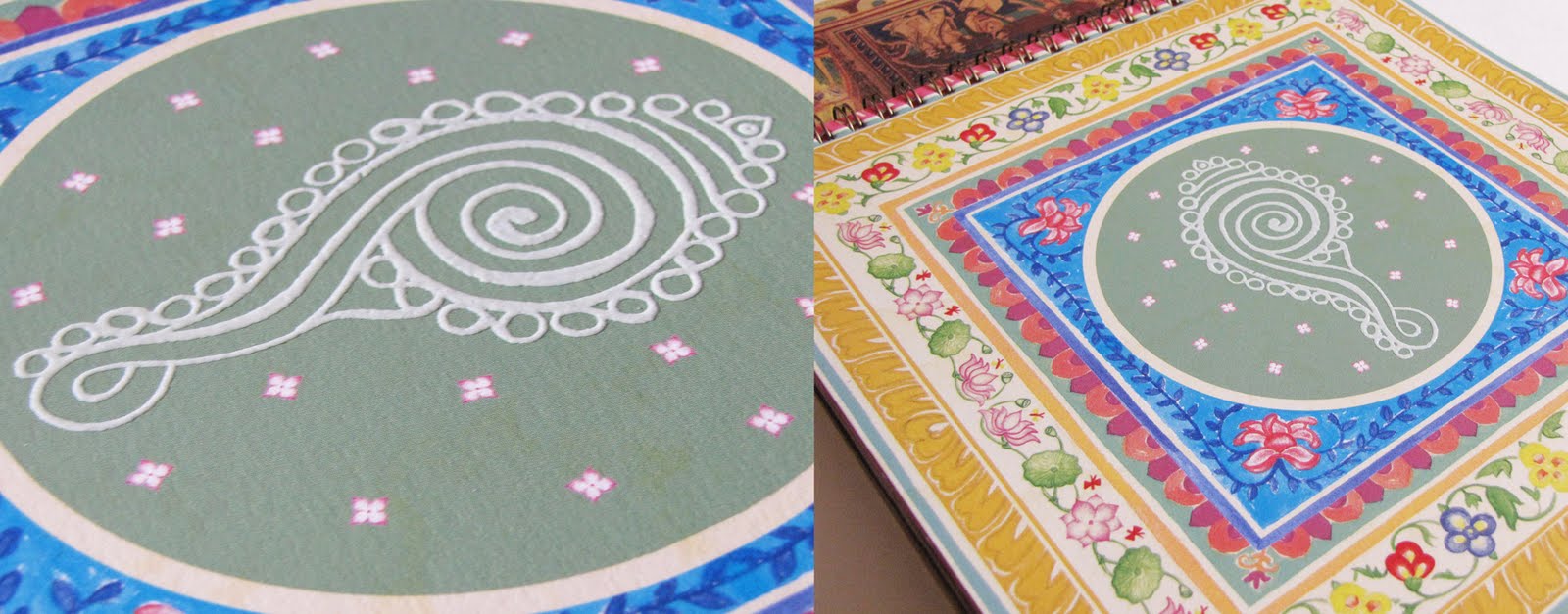
Thermography in white on the shankh imitates rice paste.


Florescent green ink in leaves of the kalpavriksh lends extra freshness


Thakur ka ghar beautifully encases the deity in the house through Sohrai painting


Abrasive UV on a yantra gives it a tactile feel giving power each time it is touched


The kamal motif in lippan kaam imitates the mirror work See process


The surya spreads its radiance in a PVC Gold screen.


A moradi or peacock guards the walls of the meena tribe from rajasthan


A cluster of ten fish or matsya bless for good luck in marriage


A mrig or a deer symbolising man in harmony with nature


The seat of the rajput warrior on an elephant sparkles with gold foil stamped embellishments


The dharmachakra spreads the wisdom rendered in tibetian wall art style with effects imitating wood through a special UV


The magical spectre of the tarpa nritya captured with silver screen for the trees

With each of these folk symbols resting on its owner's desk we hope it brings them good fortune all round the year.

Monday, December 27, 2010

Experiments with random materials : Lippan Kaam

This year around we have had the fortunate chance to experiment a lot with some projects. Mostly they are experiments with materials, printing and paper that I have already shared in my previous posts.

This one is a fresh arrival at the studio and I am excited to share it here.

For a project we wanted to replicate a particular motif rendered in Lippan Kaam : Mud work from the walls of Kutch, Gujarat, India.


This work is actually created on the walls with a clay and dung mixture, motifs are created in bas-relief mostly freehand by memory by using palms and fingers pinching and shaping the mud mixture. The white comes from the sand of this marshland that is rich in salt content. The motifs are inspired from the rich and famous embroidery patterns and once the walls are done they look stunning with mirrors embedded in the mudwork, much like the embroideries itself.

And as much I was aware of the painstaking effort in creating these from my last visit to this breathtakingly beautiful place, where would one find the exact materials here in a city like Mumbai?

And so we did this little experiment...

On a ply-board we pasted a basic outline in a black and white print of what we wanted. Then carefully pasted a white chord (used to hold pyjamas) along this outline. Even though it seemed rather simple till then, it was tricky to get the intricate bits correct. For this reason we had to alter the design several times over.

Once this was ready, we made a mixture of plaster-of-paris and glue with water to pour over this basic framework. Getting the right viscosity here was important as we tried on a small patch first. Too thick would fill up the spaces and the chords would not stand out in relief and if too thin the POP would crack instantly. After pouring the mixture over, we still had to shape it with what we could get our hands on, but mostly very patiently with fingers. And then, wait for it to dry and settle.


Did think of sticking mirrors in the mud work but realised it would never show up in print correctly. So I left this issue to be dealt with at a later stage.

Even though the original art is an all white and a simple play of textures and relief work we tried giving some colour to it on Photoshop and were happy with the results.


Once we were done touching up our artwork the issue of replicating mirrors popped again. We succeeded in resolving this issue by using highly reflective silver foiling in the areas...and viola! It looks authentic as and stunning!


Can't wait to share the rest of this project. Shall do in another post real soon.

Friday, November 12, 2010

Diwali Greetings Design


: Designed for Kalpataru Group :


: Designed for DesignMembrane :


: Designed for Square Foot, Classic Floorings Pvt. Ltd. :

Diwali, the festival of lights has just gone by and we are just back from a short vacation too. Would like to share some festive greetings that we had fun designing.

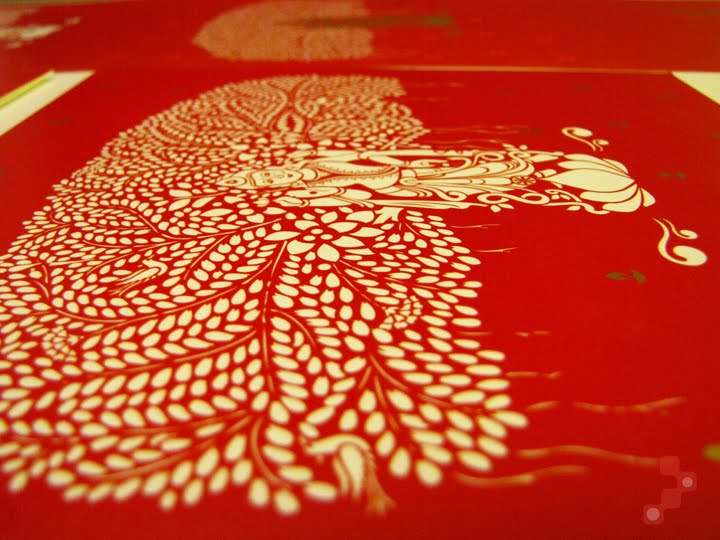
Based upon a mythological story - Lakshmi, the goddess of wealth emerges from the churning of the ocean with the kalpavriksh. Designed for the Kalpataru group. The illustration style is inspired from the stencil art of Mathura, India called Sanjhi. The message inside is a salutation to the goddess lakshmi in sanskrit delicately calligraphed by hand and refined on Adobe Illustrator. This is how the card took shape...


We had the chance to do some post production experimentation with printing on this one. Though we would have loved to have the main image in gold foil and embossed, there was little time to do so. We experimented with printing in PVC gold, keeping the colour combination a simple red and white and also in thermography to give it a raised feel.


------------------------------------------------------------------------

Our card this year was simple, wishing everyone prosperity(lotus-symbolic of goddess lakshmi) and enlightenment(diya or lamp). As it works both ways(up and down) it is subtly symbolic of the fact that the key to life is about maintaining a fine balance; prioritizing between acquiring wealth and enlightenment - both means to prosperity!


------------------------------------------------------------------------

Diwali, literally means a line of diyas. And on this simple concept was based our design for Square Foot - a flooring company. We chose the brand colours itself for better retention and recall of the brand itself to whoever received the greetings. The line inside in Sanskrit - "Tamaso mah Jyotirgamaya" translates as "may light prevail over darkness".

Do hope you had a sparkling diwali night as well :)

Friday, September 3, 2010

Award for Kalpataru Desk Calendar 2010

We are glad to hear that "Dharohar" the desk calendar we designed for Kalpataru for 2010 has won the print-shop, Parksons Graphics an award for Printweek India Social Stationery Printer of the Year.

"The judges loved the Kalpataru Desk Calendar...The 13-leaf calendar with a flyleaf and envelope strictly followed the client’s instruction – use special effects solely for enhancement and not for inteference of the design. Such jobs are indicative of a printer’s role. Print is not merely reproduction. It is geared towards exploring ideas, techniques and design collaborations."

Congratulations to the brilliant job post-production!

Friday, July 2, 2010

Measured Change -I

We are privileged to be a part of the team working on Change magazine, an in-house publication of Godrej & Boyce Mfg. Co. Ltd. and have been approached to take up its designing. The magazine has been in circulation for many years within Godrej and plays an important role to bind the conglomerate that has several businesses.

Godrej in India is a brandname we have grown up with. Rather synonymous with the iron almirahs and locks. As the new generation at Godrej takeover it is trying to strike a balance between the past and the future. With new ventures to allure the modern-young-urban Indian, Godrej has recently undergone an identity makeover by agency Interbrand.

While designing any piece of communication it is important to stick to the brand guidelines and the magazine is no exception. We at DesignMembrane have read through the extensive brand guide and hope to reflect a positive change!

As we play our part on this issue, would like to share the the cover design...

In each issue there is a theme in focus. The theme chosen is something of interest across sectors for all employees...usually strategy based, in which they discuss case studies so as to inspire employees of other units. There are other articles of general interest as well. For this issue the theme is "Chunks of Change". A strategy used for quicker results. Something that works like quicker short steps to the final goal.

This is the Change masthead.


The "G" symbol works effectively in conveying "refresh,recycle etc." As the word "Change" appears in the theme "Chunks of Change-Projects for Rapid Results" we took this as an opportunity to brand "Change" the magazine. Hence the cover illustration...


The "G" symbol from the masthead twirls for rapid results with the three brand colours.

Will share the story of the spreads and the rest in another post soon.

Sunday, January 10, 2010

Dharohar Continued

When a corporate turns 40 and has a legacy of its own it talks about the legacy of its soil at the turn of a new decade. A calendar design that was in process at DesignMembrane for the Kalpataru group is out now and we have received our copies to share in this space.


After a few rounds of theme presentations there was also a request from the client's end to develop and present on the theme of kings from different dynasties that ruled India in the past. We suggested a slight twist to it, listing down several dynasties from the first in the Vedic era to the era of post independence and seeking a derivative from each one. We knew each period would have some relevance in the present. For example, the Indian emblem came from the Mauryan times of Ashoka's pillar at Sarnath.

We called it "Dharohar", a sanskrit word that translates as "legacy".


Research was difficult initially. Our studio turned into a boring history class but with little chance of bunking it. But soon we were engrossed. It was not just about presenting the facts as is but somehow relating these with what we see around us today which is what made it interesting after all.

Soon ready with a moodboard for each month with all facts lined up with relevant images, a rough cut for the basic look and feel was also presented for the first three months so that the basic benchmark was set.

After loads of brain rattling, swapping one dynasty for another and eliminating a few, our basic theme and flow was set for the calendar (not necessarily in that order!). Our approach was a combination of pictures with illustration and we were also keen to later experiment with printing techniques but that was for later.

These dynasties with their respective legacies made it to the final cut...
*Mauryan legacy : Lion pillar-Emblem of India and the message of peace
*Cholas, Cheras and Pandyas' legacy : Dravidian architecture and a bureaucratic form of governance
*Satvahana legacy : First coinage
* Kushan legacy : The present form of Buddha
*Gupta legacy : Chess in its ancient form of Chaturanga and the beautiful cave paintings of Ajanta
*Pala legacy : First ever illustrated manuscripts
*Islamic Sultantes' legacy : The beautiful work of inlay from Bidar, Deccani painting
*Mughal legacy : The first rajput-mughal alliance:Jodha-Akbar and the message of love that emperor Shahjahan built for his beloved wife Mumtaz, the beauty of architectural forms and geometric patterns
*Rajputana legacy : Miniature paintings - Kishangarh's Bani Thani
*Maratha legacy : Shivaji's heroic tales and message of swarajya which also became the motivation behind the Indian Independence Movement
*British legacy : The Post, Railways and colonial painting
*Independent India : The spirit of freedom, National insignia - lotus, tiger and peacock

The calendar design breaks the routine perception of India often explored through kistch art forms. The photo-illustrations in a rather graphic manner aim to be both informative and evocative. Here are some pictures of the final print.


Mauryas - Indian Emblem form the Ashokan pillar in thermography to give a seal-like effect

Cholas, Cheras and Pandyas - The zari border in an imitation with screen printed gold motifs

Satvahanas - The symbol of their capital Ujjain, a cross with four circles at the ends screen printed in metallic copper

Kushans - The folds of the buddha sculpture can be felt with raised UV

Guptas - The pieces of the board game in foil

Palas - The stone wall in the background has a rough textured UV

Islamic Sultanantes - The Bidri metalware imitated with silver silk screen and foil stamping

Mughals - The emperors and their empresses in a spot UV

Rajputs - The motifs of the odhani replicated in an imitation of the real ones in gold silk screen

British - The imitation seal on the postal stamps in thermography

Independent India - The lighting on the Rashtrapati Bhavan and the motifs that represent the Indian insignia in glitter lamination to enthuse a feeling of celebration

Brilliantly printed and fabricated at Parksons Graphics, Mumbai. At our end, we kept a thumb rule of keeping "the effects" to the minimum and only in the front and not on the back side with the description text so as to not go overboard with it. All printing techniques were carefully selected for a single characteristic, only to add more meaning to the image and enhance the visual perception and sometimes add a dimension of touch, like in the folds of Gautam Buddha in the Dharohar of the Kushans.

Project Closure : Dec 2010